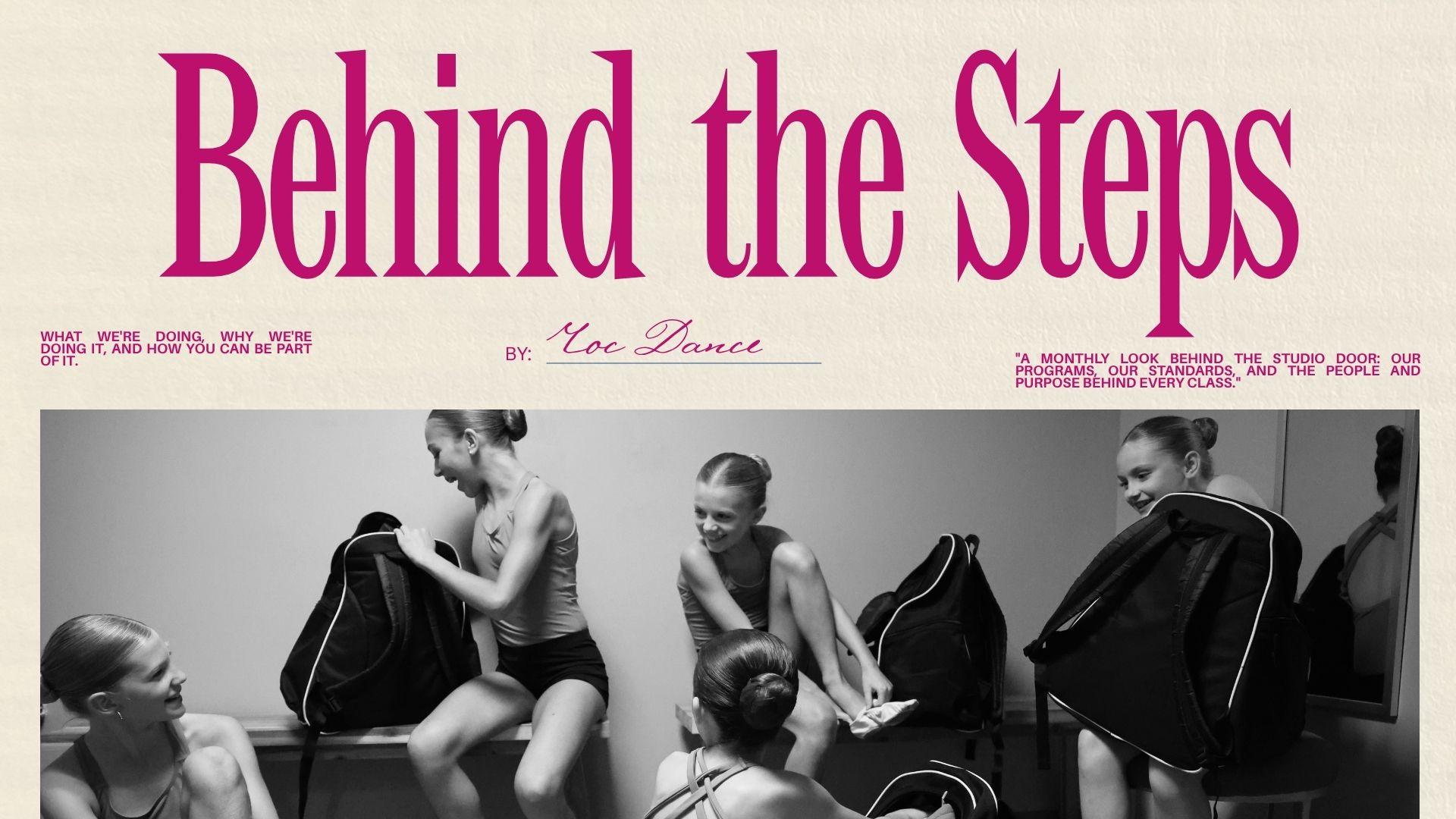
September 2026
Roc Dance
Behind the Steps | September 2026
A monthly blog from the Roc Dance leadership team: what we're doing, why we're doing it, and how you can be part of it.
Welcome to Behind the Steps
From Ms. Charlotte, Owner & Director
Welcome to Season 10, and welcome to our very first blog post!
Whether you've been with us for ten years or three weeks, I'm so glad you're here. Some of you watched this studio grow from one room in a basement. Some of you walked into our lobby for the first time this month. All of you are part of what we're building this year, and our studio family.
This blog is our way of letting you in on the part you don't usually see. Each month, you'll hear from me, Ms. Michelle, and Ms. Krista. Our goal is to explain what's happening behind the studio door, to educate you about why we do things the way we do, and to equip you with what you need to support your dancer at home. Above all, we hope it helps you feel confident that you chose the right place for your dancer.
The work you don't see
The studio may be quieter in the summer, but the work isn't. Summer is when we build the season your family is about to experience.
While the evenings are free for dinner at a 'normal time', we build the schedule and train our team. That training & collaboration is how your dancer gets the same quality of teaching in every class, whichever teacher is at the front of the room. We plan everything from the uniform ordering process to choreography assignments, so that when September arrives, it's ready.
We also take care of the building itself. We freshen up the lobby and studio rooms, and we handle the repairs that are easiest to do while no one is dancing. You and your dancers deserve a space that is clean, fresh, and built to support their learning.
By the time your dancer walked in for their first class this month, the year ahead of them had been months in the making. That's the part nobody sees, and it's the part I'm proudest of.
What we stand for
NURTURE, EDUCATE, EMPOWER have been the pillars of our mission for a decade. Here's what they look like in practice.
Nurture is a teacher who notices your child had a rough day before you do. It's why we ask how school went before we ask for a straight knee.
Educate is qualified faculty who keep training and learning. Our teachers studied dance at college, and many have professional performing experience. Credentials are only the starting point, though, and that brings me to something I care about deeply.
Why standards matter to me
If you've had a chance to chat with me, you've probably heard me say that Rochester's dance market is saturated. Dance studios are a bit like gas stations: we all sell the same thing, so it comes down to what matters to you. Do you want full service at the pump? Clean bathrooms? Is the coffee inside good enough that you overlook slow service at the counter, or the price?
For me, it was simple. I want safe, trusted adults who respect the art of dance and its legacy.
When I moved here from England, the thing that stopped me cold was that anyone can open a dance studio. No credentials, no experience, no one checking. We make sure our children's school teachers are background checked and trained for emergencies, yet the dance teacher who spends hours a week with them is often held to no standard at all. That has never made sense to me, and at Roc Dance, it's non-negotiable.
That's why we hire people who are actually trained, and why we invest in them to keep learning. It's why every member of our faculty submits lesson plans that I review personally. Your child's body and confidence are both in their hands.
Time and time again, families who come to us from other studios share stories that stay with me. Some paid for a costume that was handed over in a garbage bag. Others found that anyone off the street could watch their child's class on the lobby TV, or learned about recital picture day a week before it happened. None of that should be normal.
Standards are very important to me. My hope is that by holding firm to ours, we can help raise the bar across Rochester, and in the end, the whole dance world wins
Empower is the long game. It's the dancer who asks the question in class, who introduces themselves to an adult without looking at the floor, and who walks into a new room knowing they belong there. It's the four-year-old who waves goodbye at the preschool door and walks into kindergarten on their own. It's the eleven-year-old who makes the jump to middle school with a little more courage than they expected, and the teenager who walks into high school knowing who they are. Dance is the vehicle. Confidence is the destination.
Why we cap our classes
A teacher can only truly see so many faces at once. Past that number, your child becomes someone being managed rather than taught. So we cap our classes, even though every cap is revenue we choose not to take. It's the most expensive promise we make, and it's the one I'll defend hardest.
Five dates for your calendar
The full season calendar is [linked here / in the parent portal], but these are the five dates families most often wish they'd known sooner:
Bring a Friend Week: October 5th-10th
Observation Week: November 16th-21st
Holiday Performance: Sunday, December 13th
Recital Weekend: Saturday, June 26th
This month on the blog
Ms. Michelle our educational manager takes you inside our educational level classroom to show what your dancer is really learning, and Ms. Krista our academy manager explains what our Academy is and what being on a competition team really means.
Ten years ago this was an empty studio and a good idea. Thank you for turning it into so much more.
See you in the lobby,
Ms. Char
Owner & Director, Roc Dance
What Will Your Dancer Actually Learn This Year?
From Ms. Michelle, Educational Manager
At Roc Dance, one of our core values is EDUCATE, and that's my focus this month.
We want your dancer to have fun. We want them to make friends, build confidence, perform on stage, and love coming to dance each week.
As Educational Manager, though, there's another question that matters enormously to me: What is your dancer actually learning?
As classes get underway this month, you're only seeing a small piece of a much bigger plan. Every game, exercise, step, and combination is part of an intentional curriculum. It's designed to help your dancer grow this season and prepare them for what comes next.
There's a Plan Behind Every Class
Our Educational Faculty follows a written syllabus and curriculum map all season long. Each level has clear guidelines for what dancers are introduced to, what they practice consistently, and what we hope they can demonstrate by the time they're ready to move on.
Our teachers don't walk into class and decide what sounds fun that day. There's a why behind everything we do.
When It Looks Like Play, That's on Purpose
This is especially true for our youngest dancers.
Your dancer may tell you they pretended to be an animal, jumped over imaginary puddles, danced with a scarf, or played a movement game. You might wonder, "But what did they actually learn?"
A lot!
Creative movement develops motor planning, spatial awareness, coordination, body control, musicality, listening skills, and the ability to follow a sequence.
When we ask a dancer to tiptoe to a spot, jump over three puddles, turn around, and freeze in a shape, they think they're playing. We're teaching them to listen to directions, remember a sequence, move through space, and complete movements in order.
It looks like play because it's supposed to. We meet our youngest dancers where they are developmentally, and we lay the foundation for everything that comes later.
From First Steps to Levels 1–4
As your dancer grows, the curriculum grows with them. Skills aren't assigned to levels at random. We introduce each one when it's developmentally appropriate, then build on it year after year.
Take the plié. A dancer first learns the idea of it. Then they learn to perform it with correct alignment. Eventually it becomes the foundation for jumps and more advanced movement. The same is true of turns, rhythm, balance, flexibility, musicality, vocabulary, and combinations.
Skills stack. Level 1 prepares dancers for Level 2. Level 2 builds the foundation for Level 3, and those foundations keep developing into Level 4.
We're not trying to rush anyone. We want dancers to understand each skill, practice it, and build a strong base before we add the next layer.
We're Building Dancers, Not Just Dances 💗
When I look at our Educational Program, I don't just see a schedule of Ballet, Tap, Jazz, Hip Hop, Lyrical, and Acro. I see a pathway:
The First Steps dancer learning to listen and follow a movement sequence
The Level 1 dancer beginning to understand dance vocabulary
The Level 2 dancer connecting individual skills into combinations
The Level 3 and 4 dancer growing those foundations into stronger technique, artistry, independence, and confidence
That's why curriculum matters. It's why lesson plans matter, and why those silly games with our littlest dancers matter too.
So this year, when your dancer comes home and shows you a new step, uses a dance word you've never heard, or tells you about a game they played in class, know that there's intention behind it.
We're not just teaching dances. We're educating dancers. I can't wait to see how much they learn this season.
Ms. Michelle
Educational Manager, Roc Dance
What Is the Roc Dance Academy, and What Does "Competition Team" Really Mean?
From Ms. Krista, Academy Program Manager
At Roc Dance, one of our core values is EMPOWER, and that's my focus this month.
A new season means our Academy teams are back in the studio, learning new choreography and getting to know their teammates. If you're new to Roc Dance, you may have heard your dancer talk about "the Academy" or "Competition team" and wondered what that actually means. If you're a returning family, this is a good reminder of why we do it the way we do.
What the Academy is
The Academy is our competitive training program. Academy dancers take more classes each week, focus more deeply on technique, and learn group routines they'll perform throughout the season. This year we have five teams: Rising Stars, Roc Stars, Minis, Juniors, and Teens.
It's still the same Roc Dance, with the same teachers, the same values, and the same care. There's simply more of it: more training, more performing, and more commitment from the dancer and their family.
What actually happens at a competition
A dance competition is a weekend event where studios from across the region perform their routines on stage. Each routine is scored by a panel of judges, who are experienced dance professionals, and dancers receive feedback on their technique, performance, and presentation.
This season our Academy will attend five regional events between March and May, from Rochester to the Philadelphia area. For many dancers, these weekends become some of their favorite memories of the whole year.
What competition is not
Competition isn't about trophies, and it isn't only for the "best" dancers.
The scores and awards are fun, but they're not the point. The real value is what happens along the way. Dancers learn to prepare for a deadline. They learn to perform under pressure and take feedback from someone other than their teacher. They learn to show up for a team that's counting on them. Those skills last long after the music stops.
What the commitment looks like
Being on a team means being part of something bigger than yourself. Group routines only work when everyone is there, so attendance matters more in the Academy than anywhere else in the studio. When one dancer misses rehearsal, the whole team feels it.
It's a commitment for families too, with rehearsals, competition weekends, and travel. We work hard to make that manageable. Our Team Hub gives Academy families the schedule, policies, and competition guidance in one place, and I'm always happy to answer questions.
Teammates, not just classmates
One of my favorite parts of the Academy is our Bigs & Littles program, which pairs older dancers with younger ones as mentors. Our older dancers learn leadership. Our younger dancers gain someone to look up to, cheer for, and learn from. It's one of the clearest examples of what team culture at Roc Dance looks like.
How dancers join the Academy
Educational Program dancers who may be ready for the Academy are identified through our end-of-season recommendations. An invitation is about more than talent. We look for consistent effort, focus, a positive attitude, a strong work ethic, readiness for a bigger commitment, and a genuine desire to grow.
If your dancer dreams of joining a team one day, the best thing they can do is exactly what they're already doing: show up, work hard, and love it.
Why it matters
When we watch an Academy dancer walk off stage, we're not thinking about the score. We're thinking about the nervous dancer from September who now knows they can do hard things in front of an audience.
That's how we EMPOWER dancers.
Ms. Krista
Academy Program Manager, Roc Dance